Spiga
Showing posts with label Industry and Economy. Show all posts

Infosys Invests $ 1.9M for R&D Efforts in Australia

Infosys (NASDAQ:INFY) has invested in the future of Australia's IT services industry, committing up to AUD$1.9M in cash and services to the newly formed Smart Services Cooperative Research Centre (CRC). The program, launched yesterday by Senator The Hon. Kim Carr, Minister for Innovation, Industry, Science and Research, will bring together the best technology minds from industry, six Australian universities and Government to develop an ambitious R&D program aimed at creating intellectual property (IP) of value to Australia's services market - with initial demonstrators planned for the finance, media and government sectors.
Over the course of the program, this IP will be engineered and commercialized by CRC participants resulting in new technology products and services that will increase the competitiveness of Australia's IT industry and make the services market more innovative. As the only global IT services Company involved with the program, Infosys is spearheading the Smart Service CRC from a technology perspective alongside SAP, with industry heavyweights Including Telstra, Fairfax Digital and Suncorp Metway actively involved in setting the research agenda.
World-class researchers from around the country will also contribute to the R&D and IP creation. "Innovation is imperative for growth and with Australia an emerging market on the global IT stage, we're pleased to be contributing to the development of the industry in such a significant way," said Gary Ebeyan, Chief Executive Officer of Infosys Australia.
"The good part of the Smart Services CRC is that we get to work with not only the best and brightest minds from academia but also the private sector - some of whom are our clients. With these companies actively setting the research agenda, our clients as well as the IT industry would be able to reap long-term benefits of this IP development."
Infosys' participation in Smart Services CRC is a joint venture between its Australian subsidiary (Infosys Australia) and SETLabs, the Company's research group, headquartered in India. As part of the collaboration, Infosys Australia and Infosys' SETLabs will initially focus on three research projects exploring business process innovation and service orientated architecture (SOA).
"The CRC program will extend on the research currently being undertaken by SETLabs and provide valuable insights into the needs of the Australian market. It's a good example of how Infosys is thinking globally and acting locally," Ebeyan explained.
Warren Bradey, CEO of Smart Services CRC, said: "The inclusion of a trans-national partner such as Infosys in Smart Services CRC provides us with the opportunity to truly draw on world-leading development techniques for new services and also extends through this valuable partnership, an ability to take the output of our research and apply them on a global scale.
"The Smart Services CRC will also focus on producing graduates with the skills required to alleviate the industry's skills shortage through its close association with Australia's leading universities. For a number of years Infosys has been collaborating with academic institutions through joint research collaboration, its global internship program in as well as its industry-academia program Campus Connect. It plans to use its involvement with Smart Services CRC as a platform to continue this work. The Smart Services CRC research program will commence in the second half of 2008.
Fried stocks, wind power & more

Stocks deep fried as oil boils over
Indian benchmark indices have declined to their lowest levels since August of last year. Factors like record high crude prices and the spectre of rising inflation are acting as bugbears for the markets.
The spike follows rising concerns of an Israeli attack on Iran. As a matter of fact, Iran is the second-largest oil producer within the OPEC (Organisation of the petroleum Exporting Countries) cartel and any interruptions in its exports could push prices higher levels. And if the OPEC President’s remarks are something to go by, a barrel of crude oil can hit US$ 170 in a short span of time. He, however, anticipates these prices to fall towards the end of the year, not expecting a barrel’s cost to touch US$ 200 as has been predicted by some commodity analysts in the US.
As for the global stock markets, while the US markets closed marginally in the positive yesterday, the Asian indices have maintained their losing streak today as well. Stocks in Hong Kong and Japan are down 1.4% and 1% respectively. However, Chinese markets are up 1.6% currently.
Zeroing in on energy efficiency

The meeting of the G-8 (Group of Eight) countries in July this year will have several important agendas. The centre stage will be taken by the discussion on energy efficiency. India itself will be a strong participant in this having initiated a 'climate change' plan weeks before the meet.
The Indian government has pledged to devote more attention to renewable energy, water conservation and preserving natural resources in the country's first-ever climate change plan, but it did not set any concrete goals or pledge to cap harmful emissions. According to the recent World Bank data, India is the fourth-largest emitter of carbon dioxide (the main gas linked to climate change) after the US, China and Russia. On a per person basis, though, Indians emit far less carbon dioxide than people in those countries and European nations.
According to the report, the average Indian generates about one-tenth the amount of carbon dioxide as someone in Japan or Europe, and one-twentieth that of an American. According to the scientists in the West, blistering economic growth and huge populations in India and China mean these countries are contributing more to the growth of emissions than developed countries. But, on a per-person basis, these nations still produce far fewer pollutants and gasses than developed countries. Thus, China and India would argue that this is how their contribution to climate change should be judged.
It may be recalled that in April this year, the US President Bush pledged that his country would halt the growth of greenhouse gas emissions by 2025, without giving any specifics about how that would happen. This was after US had long resisted emission caps and refused to join the Kyoto Protocol on limiting such emissions. On the other hand, China's first climate change plan released last year called for improved energy efficiency and expansion of renewable and nuclear energy sources. But none of the targets were really met.
Windy times ahead

The International Herald Tribune had recently reported that wind power is gaining advocates in the US, the world’s second biggest polluter after China. While only 1% of US electricity comes from wind, it is attracting so much support in that country that many in the industry believe it is poised for growth.
The report goes on to state that ‘last year, a record 3,100 turbines were installed across 34 US states, and another 2,000 turbines are now under construction from California to Massachusetts.” In all, there are more than 25,000 turbines in operation in the US, set up with an investment of US$ 15 bn. Last week, the US Energy Department has indicated that, by 2030, wind power could provide 20% of US electricity, or 304 gigawatts (GW), up from the current set up of 16.8 GW (a compounded annual rise of 14% in wind power capacity).
Indian wind power equipment suppliers like Suzlon Energy are already charting the path to opportunities in the global markets, including the US, Europe and China. The US is, in fact, one of the company’s largest markets and it had set up a manufacturing capacity there in 2006. However, while the opportunity for the company is huge, these come with a set of constraints like that of key equipment supply and logistics. Then, the company had recently faced breakage issues with some of its wind turbines in the US, for which it had to set aside Rs 1 bn as provisions.

Opportunities in power transmission

Power transmission plays an equal if not a bigger part in a nation’s power sector growth as compared to the generation and distribution segments. The transmission segment involves companies that are involved in transmitting power generated at the plant to the distribution company (for the latter to ultimately distribute it to final consumers of power) along with engineering companies that set up transmission projects and manufacture equipments such as transmission lines, power cables, transformers, switchgears and control gears.
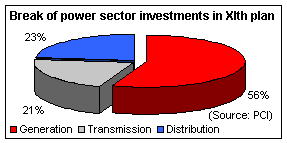
In the past, (state) governments have not given much attention to the transmission segment but rather have been focusing on the generation aspect. However, it is important to understand that in order to achieve the plan of increasing the total generation capacity by nearly 70% to 200 GW (gigawatts; 1 GW = 1,000 MW) by 2012, the focal point should be distributed equally amongst all the three aspects of generation, transmission and distribution.

Observing this, second year into the current five-year plan, the officials from the Ministry of Power (MoP) have suggested certain initiatives to facilitate the process of improvements in the transmission segment. One of which includes utilities making it a habit to place large transmission orders every year (for around 20,000 MW of generation capacity) rather than clogging up the order books of the respective companies towards the end of the plan period. Further, nearly half the investments made on generation should be made towards the transmission side as well. Another good recommendation made by the officials was to review the plans on a bi-annual basis rather than on a five-year basis.
Issues with power transmission
There have been a few issues that the transmission sector has been facing, with quite a few of them interlinked to one another. One of them includes constraints with respect to the equipment supplies. There are very few experienced and established players in the market who provide equipment on a large scale, thus leading to usage of non-good quality material and gear. For example, there have been numerous cases of pollution and humidity causing tripping and blink-outs in wires. This indirectly translates as a strong opportunity for the major established equipment manufacturers like ABB, Siemens and Crompton Greaves, that have reputation for quality and have product offerings across the transmission value chain.
While engineering companies in India have benefited tremendously over the past few years due to large orders being given by the power generation companies, the fact that investments in power transmission and distribution are yet to scale up, provides them with a whole new set of opportunities in the future.

Solar Semiconductor signs $1.2-b delivery pact with SolarWorld

July 2 Solar Semiconductor has signed a delivery agreement with SolarWorld AG subsidiary Deutsche Solar AG, which operates one of the largest factories worldwide for the production of multi-crystalline solar silicon wafers.
The agreement is a multi-year contract for the delivery of wafers worth over $1.2 billion (Rs 5,160 crore).
The tie-up would help Solar Semiconductor, which has manufacturing facilities in Hyderabad, to strength its position as a rapidly growing international manufacturer of high-quality solar photovoltaic (PV) modules.
“We are pleased to conclude a long term wafer-delivery agreement with SolarWorld AG,” commented Mr Hari Surapaneni, Chief Executive Officer of Solar Semiconductor.
“One of the key raw materials is the cell, which derives its high quality from the source wafer. As a rapidly growing manufacturer of high-quality modules, it is important to assure our customers that we not only use cells from reputed manufacturers, but also employ high-quality wafers to ensure high-quality cells,” he said in a press release.
“With this wafer contract we are securing the capacity utilisation of the first expansion stage of our new wafer factory in Freiberg,” said Mr Frank H. Asbeck, Chairman and Chief Executive Officer of SolarWorld AG.
Shortly, the group will start construction of the new wafer factory in an industrial park near Freiberg, Saxony. In the first expansion step the capacity at the Saxony location will be increased to a total of 750 MW, by adding 250 MW by 2009-end.
Apart from grid-coupled (on-grid) products the SolarWorld Group also sells off-grid solar power solutions. It employs about 2,000 people worldwide.

Google